
E-invoicing is evolving at lightning speed. Where it used to be mostly about moving from paper to digital, today it’s all about automation, efficiency and compliance. A concept that is increasingly emerging within this context is self-billing. But how exactly does that work? And more importantly, how does self-billing fit within Peppol, the network that is becoming the international standard for e-invoicing?
What can you read on this page?
What is self-billing?
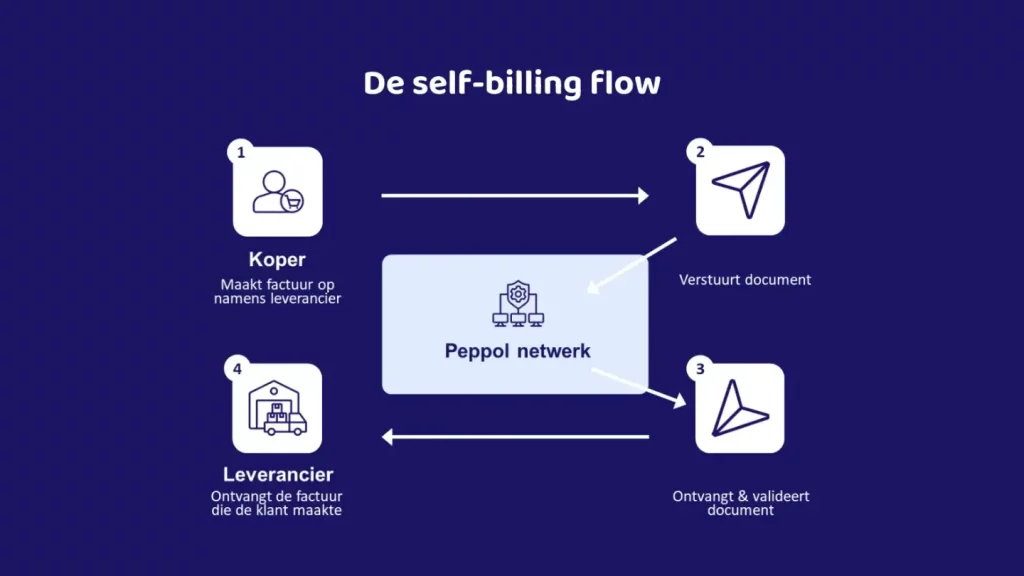
In self-billing, the customer takes over the supplier’s role in the billing process. This means that the buyer itself prepares and sends an invoice to the supplier, rather than the other way around. So the supplier no longer has to issue an invoice, but receives one from the customer.
This model is interesting when the buyer has the most reliable transaction data. Consider retail, logistics or manufacturing, for example, where the buyer often has better visibility into volumes, deliveries and prices.
Is self-billing possible in Peppol?
Yes, Peppol supports self-billing documents through the standard Peppol BIS Billing formats. A self-billing invoice broadly follows the same structure as a regular e-invoice, with an additional indication that the invoice was prepared by the customer.
It is important to note that self-billing is a separate document type. As with credit notes, recipients must register to receive this document type. Specifically, this means:
If you want to send a self-billing invoice, the recipient must be registered to receive self-billing invoices.
If the supplier (for example, a farmer) is not registered for self-billing, a self-billing invoice cannot be sent through Peppol.
The sender of the self-billing invoice does not have to register separately to send self-billing invoices, but must be able to prepare a correct self-billing invoice according to legal and Peppol standards.
In this way, self-billing invoices can be fully integrated within existing Peppol flows. Suppliers receive the invoice directly through the Peppol network, fully compliant with applicable international standards, while correctly complying with all registration and document type requirements.
What is the legislation around self-billing?
Self-billing is permitted, but never mandatory. A company cannot legally force a supplier to use self-billing. The supplier must explicitly agree to this.
In practice, however, that choice is not always free. In sectors such as agriculture or commodity trading, it is common for a larger buyer, such as a potato wholesaler, to impose self-billing on its suppliers. For smaller suppliers, such as farmers, the agreement is often a condition of continued supply. The power relationship between customer and supplier thus plays an important role here.
When both parties agree to self-billing, the following applies:
The invoice issued by the customer is an official VAT invoice
That invoice must comply with the same legal and VAT rules as a regular sales invoice
In countries where e-invoicing through Peppol is mandatory, self-billing invoices must also be sent through the Peppol network
In addition, it is also possible to work with self-billing credit notes, for example in the case of corrections or subsequent price agreements. These credit notes also follow the same rules as regular VAT credit notes and are part of the e-invoicing process.
Does every Access Point offer self-billing?
A Peppol Access Point is not required to offer self-billing to its customers. Thus, it may happen that an Access Point does not provide a solution for self-billing. This may have several reasons: for example, because the type of customers of that Access Point does not involve it, because the processing is technically complex, or because the software, ERP or AP tool used cannot format or process self-billing.
However, this does not mean that a self-billing invoice can simply be sent via e-mail. Self-billing invoices must be sent via Peppol, as an official and legally correct document.
When dealing with self-billing, it is therefore important to choose an Access Point or software that offers a robust solution for this, such as Nymus. Our customers can send and receive self-billing invoices through Peppol regardless of their ERP system, be it SAP, Business Central or any other system. Fully compliant with legal and technical requirements.
Why is self-billing interesting for large enterprises?
Self-billing is especially interesting for buyers who have more data and use more sophisticated systems, such as a potato wholesaler. They can relieve the supplier, for example a farmer, of the work of preparing an invoice themselves, while being immediately sure of the correct quantities and prices.
This saves both the buyer and the supplier valuable time and ensures more efficient operations. The result: faster payments, lower administrative costs and greater visibility. In industries with thousands of transactions per month, this can have a significant impact on both operational efficiency and cash flow.
Why is setting up self-billing correctly so important?
Self-billing invoices are a more complex exception within the billing process. In many companies, the majority of invoicing, about 80% of invoices, goes smoothly and without problems. But precisely that remaining 20% of invoices, including self-billing, can require a disproportionate amount of time and manual effort.
By properly setting up self-billing up front and carefully addressing exceptions, a company can realize huge time and cost savings. It allows for smoother workflows, fewer errors and faster processing of both incoming and outgoing invoices.
At Nymus, we have years of experience in providing e-invoicing and Peppol solutions for large companies with a complex finance and IT landscape. For such organizations, a simple “Peppol button” is often not enough. We ensure that even complex cases such as self-billing can be processed correctly and efficiently, allowing finance and IT teams to spend their time on important tasks instead of exceptions.
Checklist: how to get started with self-billing
Self-billing document and registration
The customer sending the invoice need not be registered, but is responsible for the correct creation and sending.
Self-billing replaces traditional sales invoices.
The supplier must be registered to receive incoming self-billing invoices.
Self-billing is used as a separate type of billing document from a regular sales invoice.
A company is not required to send or receive self-billing invoices.
Self-billing in Peppol
If you agree to use self-billing, these invoices must be exchanged through Peppol.
Verify that the selected Peppol Access Point can perform self-billing correctly technically.
Observe VAT rules and Peppol-UBL standards to avoid disapprovals or tax corrections.
Practical Tips
Make clear agreements with suppliers and customers about who applies self-billing.
Research the technical and fiscal process in advance to avoid problems.
Make sure all parties involved know who has what responsibilities in the self-billing process.
Future Prospect
Self-billing is only likely to become more important in the coming years. With the increasing obligation for e-invoicing and e-reporting within the EU (such as under ViDA), the need for automated and reliable invoice flows is growing. Large companies that invest in self-billing today will soon be one step ahead: they will save time, reduce errors and be fully ready for future international standards.
Frequently Asked Questions
FAQ
Is a self-billing invoice a different type of XML (XSD schema) than a regular invoice?
Yes. Self-billing is a separate document type with specific rules, but the content largely corresponds to a regular invoice: invoice number, amounts, VAT and supplier/customer remain the same.
Does Nymus support self-billing?
Yes. Nymus offers a complete self-billing solution, allowing suppliers and buyers to exchange invoices compliantly and streamlined through Peppol.
How is self-billing replacing traditional purchase and sales orders?
Self-billing invoices are automatically created by the buyer and sent to the supplier. All relevant data, such as invoice number, amounts, VAT and supplier information, are included according to Peppol and VAT rules. Thus, self-billing replaces statements, while maintaining content and compliance and reducing manual processing.
What exactly is self-billing?
Self-billing is a process in which the buyer prepares and sends the invoice on behalf of the supplier. The supplier receives the invoice instead of creating it himself.
Is self-billing legal in Europe?
Yes, but conditions apply: there must be a prior agreement between buyer and supplier, the supplier must accept the invoices, and the invoices must comply with VAT and e-invoicing rules.
What are the benefits of self-billing for large enterprises?
Self-billing saves time and costs, improves data quality, speeds up payments and makes billing processes more efficient and scalable, especially with thousands of transactions per month.
Download our white paper on self-billing in Peppol
HIGHLIGHTED ARTICLES