More countries, more obligations. But not more suppliers. Nymus acts as a central compliance layer between your ERP and local e-invoicing networks worldwide.


Compliance calendar
E-invoicing is no longer a thing of the future. Here you’ll find the deadlines for the countries where your branches, customers, or suppliers are located. Is your country not listed? No problem, we can handle e-invoicing in any country.

Peppol is mandatory for all B2B and B2G transactions.

E-reporting and e-invoicing have been mandatory since 2019.

E-Factura is mandatory for all transactions.

E-invoicing via KSeF has been mandatory since 2026.

Mandatory via a plateforme agréée (PA) since September 2026. Small businesses must also send e-invoices starting in September 2027.

Receiving has been mandatory since 2025. Sending becomes mandatory from January 2027 for companies with revenue above €800,000, and from 2028 for everyone.

E-invoicing through an accredited ASP will be mandatory for large companies starting in January 2027.
B2B e-invoicing via Peppol will be mandatory starting in January 2027, with reporting to the government.

B2B e-invoicing will be mandatory for large companies starting in October 2027, followed by a phased rollout for the rest.

Draft bill approved; phased implementation in 2028 and 2029.

B2B e-invoicing will be mandatory for VAT invoices starting in April 2029.

Mandatory B2B e-invoicing and digital reporting are scheduled to take effect in July 2030.
The challenge
Belgium uses Peppol, Poland uses KSeF, and Italy uses SDI, each with its own formats, networks, and update cycles.
Without a central platform, each branch has its own contract, integration, and compliance monitoring. That isn't scalable.
Legislative changes in Romania or Poland have a direct impact. Who keeps track of them, your team or your supplier?
International e-invoicing is part of Nymus Connect. You connect your ERP once, and we make sure your invoices are sent and received correctly in every country.
You connect your SAP, Business Central, or other ERP system to Nymus just once. After that, all your international invoicing goes through that single connection.
We receive your invoices in Nymus JSON format. We convert them to the format required by each country, including all the data that is mandatory there.
Thanks to this global format, we send and receive e-invoices in every country through the network used there.
One team follows up your invoicing, in any country. No local suppliers and no separate contracts per country.
Track the status of each invoice in real time, across all countries and networks, all in one place.
More and more countries are making e-reporting mandatory. We’ll handle that reporting for you as well, so all the information is in one place.
E-invoicing requirements vary by country: your Belgian branch invoices Belgian customers via Peppol, and your Polish branch invoices Polish customers via KSeF.
Each branch sends its invoices to us from your ERP in Nymus JSON format, using the integration you already have.
Nymus converts the invoice to the required format for the country where the branch is located and adds the local data.
The invoice is sent to your customer via that country’s network, such as Peppol, KSeF, or SDI. You can track everything in a single overview.
Why Nymus
Why companies with branches or customers in multiple countries choose Nymus.
If you expand into a new country, we'll expand with you. If we don't yet support a country, we'll set it up for you. That way, you'll never need a second provider.
A new country isn't a new IT project. Your existing integration simply gets the additional fields required by that country. This way, you go live faster, at a lower cost, and without any extra work for your IT team.
Our e-invoicing expert, Leentje De Brouwer, serves on the Executive Committee of GENA, the global umbrella organization for e-invoicing service providers. So we don't just follow where e-invoicing is heading, we help steer it.
Your invoices contain sensitive data. Nymus is ISO/IEC 27001:2022-certified, so your data is handled properly.
Hear firsthand how Orac handles e-invoicing for purchase and sales invoices using SAP, and how it remains compliant as the company expands country by country.
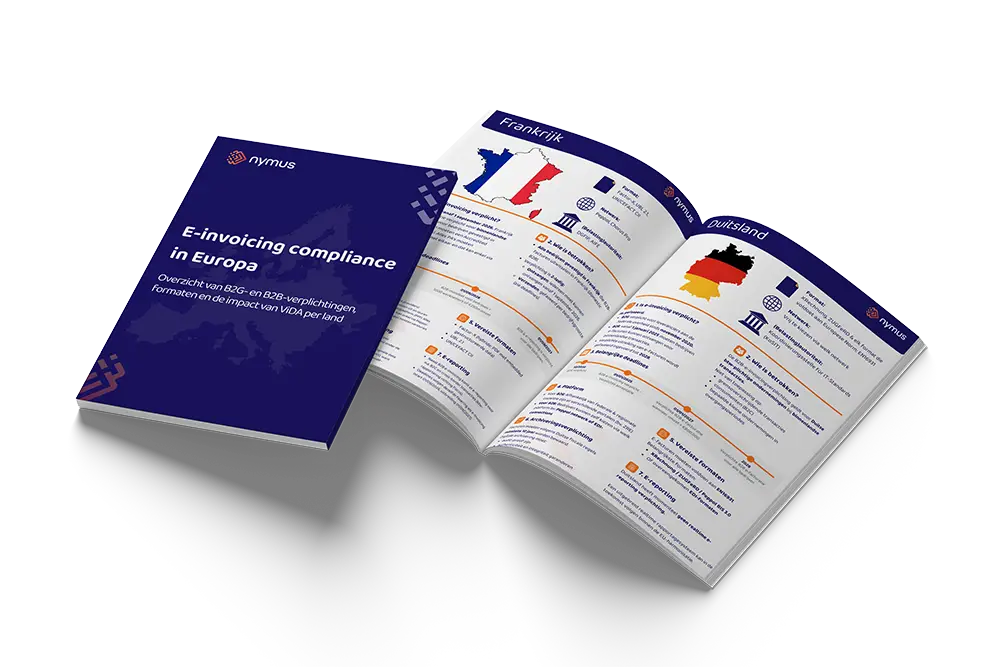
Download our whitepaper and find out what obligations apply by country and how to prepare your ERP system.
No. E-invoicing requirements currently apply on a country-by-country basis to invoices between businesses within that country. Your Belgian branch invoices Belgian customers via Peppol. If that same branch invoices a customer in Poland, the Polish KSeF requirement does not apply there. If you have a branch in Poland, that branch must send its Polish invoices via KSeF.
There will be an obligation for invoices between EU countries: from July 2030, the EU introduces e-invoicing and digital reporting for cross-border B2B transactions through ViDA.
Peppol is an international network for exchanging e-invoices; it has been mandatory for B2B transactions in Belgium since January 2026, among other things. KSeF is the Polish government platform: every invoice first goes through the government, which validates it and assigns a unique KSeF number. XRechnung is not a network but a German e-invoice format, alongside ZUGFeRD. In Germany, you can send these formats via Peppol or other channels.
So, every system has its own formats and technical requirements. Nymus automatically converts your invoices to the correct format and channel for each country.
With e-invoicing, a structured invoice is sent electronically from the supplier to the customer. With e-reporting, you send invoice or transaction data to the tax authorities. More and more countries are combining the two: France requires both e-invoicing and e-reporting for B2C and international transactions, among others, and Belgium will introduce e-reporting starting in 2028.
Nymus also handles that reporting for you, so all your invoicing and reporting information is in one place.
No. Nymus acts as central middleware between your ERP (SAP, Microsoft Business Central, F&O, Oracle, or a legacy system) and all local networks. You connect your ERP to Nymus just once. All countries, formats, and networks are then handled through Nymus.
Yes. Nymus is specifically designed for complex environments where different locations use different ERP systems, for example, SAP at headquarters and Business Central at a subsidiary. Nymus serves as a central orchestration platform that consolidates all systems and countries into a single compliance overview.
Then we’ll build it. Since we work with a single global format, Nymus JSON, we simply add the requirements for a new country. You can expand your existing integration to include the additional fields that country requires, without having to start a new integration project.
Please let us know in advance in which countries you are currently operating or plan to operate, and we’ll work with you to plan it out.
Nymus actively monitors regulations through its own expertise and the GENA network of local partners in every supported country. When legislation changes, our customers are updated automatically. You don’t need to set up your own monitoring process. That’s our responsibility.
Every country has its own deadlines, formats and networks. Tell us in which countries you operate, and our experts will map out what becomes mandatory for each branch, and when.