Slovakia is sticking to January 1, 2027, as the start date for mandatory B2B e-invoicing. At the same time, the government introduced a bill providing for a six-month penalty-free transition period, and the tax authority published additional practical guidance. If you have entities in Slovakia, read on to find out what’s new and what steps you can take now.
The most important points in a nutshell
- The requirement will still take effect on January 1, 2027. The bill does not change that date.
- A grace period from January 1 to June 30, 2027, is proposed. The proposal has not yet been approved.
- The reporting requirement for buyers would be eliminated. Suppliers would still be required to report.
- By the end of September, just under 10,000 taxpayers had selected a certified provider.
What can you read on this page?
What's new in Slovakia?
On September 24, 2026, the Slovak tax authority reported that just over 10,000 taxpayers had selected a certified Delivery Service Provider. In Slovakia, such a provider is called a “Digital Postman”: the party that sends and receives your e-invoices. With the deadline approaching, that is a low number, and the authorities therefore emphasized the urgency of making a choice.
In addition, on August 27, 2026, the government submitted a bill amending the VAT Act and adjusting the framework for e-invoicing and digital reporting. The bill passed its first reading in parliament in September.
What does the new bill propose?
A six-month grace period
The most important measure is a penalty-free transition period from January 1 to June 30, 2027. A three-month period had previously been considered. The start date itself therefore remains January 1, 2027. In practice, the first few months will serve as a live pilot: companies will not be penalized for certain shortcomings related to e-invoicing during this time. As in other countries with a mandatory e-invoicing requirement, this does not mean you can wait. You must still be ready for the go-live, but mistakes made early on will cost you less.
No more reporting required for buyers
The May 2026 draft for public comment still included a temporary deferral of the reporting requirement for domestic invoice recipients. The new proposal eliminates that requirement entirely: buyers are no longer required to report data on the e-invoices they receive. However, the digital reporting requirement remains in effect for suppliers.
What did the Slovak tax authority clarify?
In its September 24 announcement, the tax authority addressed the questions companies are currently asking most frequently:
- who must choose a Digital Postman starting January 1
- the key criteria for choosing a provider
- the difference between selecting a provider on the tax portal and signing a contract
- who is authorized to select a provider on behalf of a taxpayer
- how many providers you may have for receiving and issuing e-invoices
- how and when you can switch providers
- Using the Peppol Directory to verify whether a customer can receive e-invoices
- voluntary implementation and testing before January 1, 2027
Read the full announcement (in Slovak) for the answers.
What practical assistance is available?
On the eFaktúra portal, the tax authority has further expanded the documentation. There you’ll find, among other things, additional guides, more than 150 frequently asked questions, and updated lists of certified providers and providers currently undergoing accreditation. The Slovak Peppol BIS specifications have been updated to version 1.11.
What does this mean for you?
If you have Slovak entities, the schedule remains the same, even if the grace period is implemented. Here’s what you should do now:
- Choose a certified Digital Postman and sign a contract. Selecting one on the portal is a separate step.
- Conduct a voluntary test before January 1, 2027, so you won’t need the grace period to fix basic errors.
- Designate someone to be responsible for digital reporting as a supplier.
- Follow the progress of the bill: the grace period and the elimination of reporting requirements for buyers are not yet final.
How do you approach Slovakia without building a separate integration?
When it comes to international e-invoicing, each country often requires its own approach. Slovakia adds a certified provider and reporting requirements to the mix. For a group with multiple entities and ERP systems, things can quickly become confusing if you build a separate integration for each country.
At Nymus, we therefore use a single global format: our proprietary Nymus JSON. You connect your ERP to Nymus just once. For countries where it’s required, we add additional fields to that format, ensuring you remain compliant in every country where you operate.
Would you like to know what that looks like for your ERP landscape? Learn more about international e-invoicing with Nymus Connect.
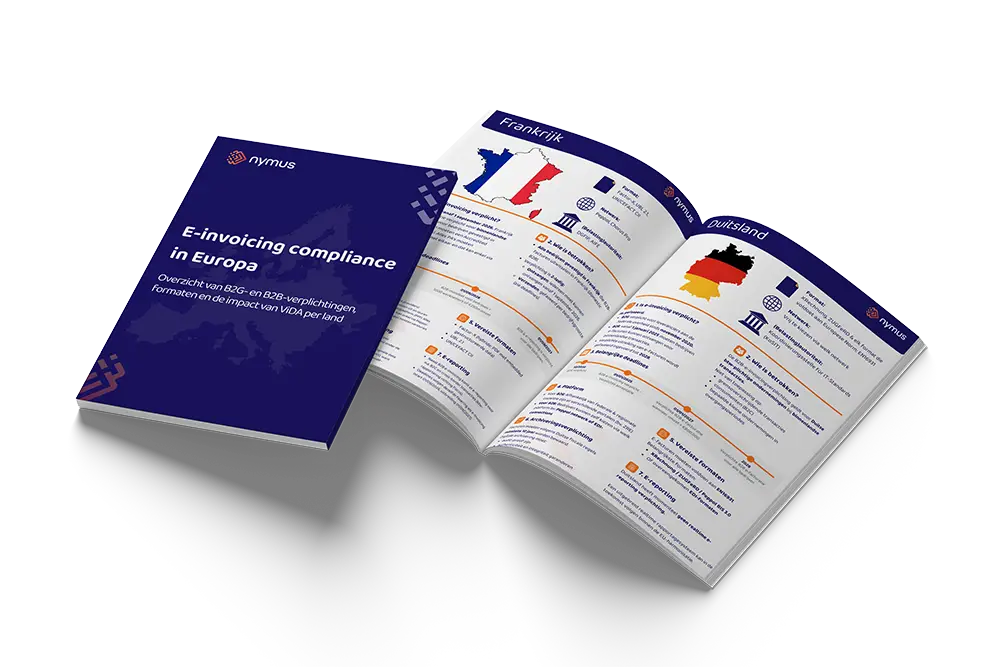
White Paper: An Overview of E-Invoicing Requirements in Europe
Slovakia, France, Germany: Each country has its own deadlines, formats, and reporting requirements. Download our white paper to find out what applies in each country and how to prepare your ERP system.
FEATURED ARTICLES