On October 5, 2026, Order HAC/1028/2026 was published in the Spanish Official Gazette (BOE). This ministerial order sets forth the technical and operational rules for mandatory B2B e-invoicing in Spain. The timeline set forth in Royal Decree 238/2026 from March remains unchanged, but the countdown has now officially begun. If you have Spanish entities, now is the time to prepare.
What can you read on this page?
The most important points in a nutshell
- Starting October 6, 2027, companies and self-employed individuals with annual revenue exceeding 8 million euros must be able to send and receive e-invoices. All others will follow on October 6, 2028.
- You can choose between the public AEAT solution and a private platform. With a private platform, a certified copy is also sent to the AEAT.
- In addition to the invoice format, there will be reporting on invoice status and payments.
- Do you sell to Spanish customers from Belgium? In that case, Belgian rules apply, not Spanish ones.
- Veri*Factu is a separate system and has been postponed until October 2028 for the time being.
What exactly was decided in Spain?
Spain requires companies and self-employed individuals to exchange B2B invoices electronically. Order HAC/1028/2026 takes effect on October 6, 2026, and supplements the Royal Decree with the detailed framework: data model, channels, status reporting, and operational procedures. The deadlines remain unchanged, but it is now clear how the requirement works from a technical standpoint.
What are the deadlines?
Spain is phasing in the requirement based on annual revenue:
- October 6, 2027: Businesses and self-employed individuals with annual revenue exceeding 8 million euros must be able to send and receive e-invoices. This group will also be subject to the requirements regarding invoice status and payment reporting.
- October 6, 2028: All other businesses and self-employed individuals must be able to issue and receive e-invoices.
- October 6, 2029: Status reporting and payment reporting will take effect for the categories that were granted an additional transition period.
In addition, a temporary rule applies: during the first year, companies with revenue exceeding 8 million euros must include a legible copy (such as a PDF) if the recipient is not yet able or required to receive e-invoices. No grace period has been announced at this time. It’s wise to continue monitoring this situation.
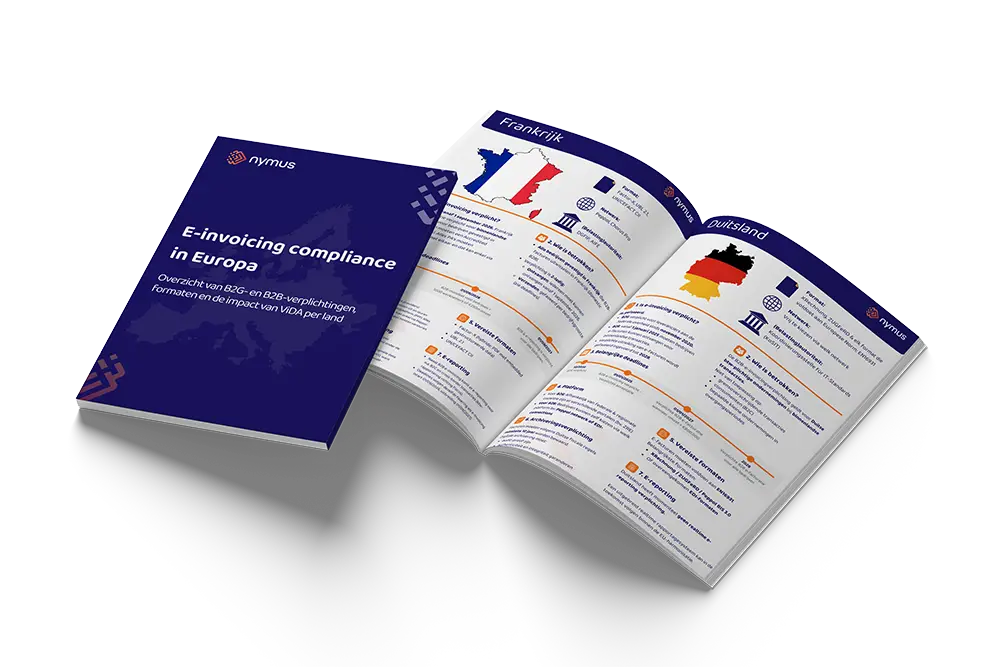
Would you like to compare this overview with other European requirements? In our white paper, you’ll find the deadlines, formats, and reporting requirements for each country. Download the white paper
How do you send e-invoices in Spain?
You have two options: You can use the Spanish Tax Agency’s (AEAT) public e-invoicing solution, or you can use a private e-invoicing platform. If you choose a private platform, you must also submit a certified copy (“copia fiel”) of each invoice to the public AEAT solution, in the format and data model specified in Annex I of the decree.
That data model is based on the semantic model of EN 16931, the European standard for e-invoicing. The decision itself does not specify a syntax. During a technical webinar in September, the AEAT announced that UBL 2.5 will be the syntax for the public solution. This has not yet been formally confirmed in the regulations, so keep an eye on this.
What changes are coming to status reporting and payments?
This is the part that will affect finance teams the most. An invoice is automatically considered accepted if no rejection or corrective invoice follows. The decision does not specify a deadline by which you must reject an invoice or after how long an invoice is deemed tacitly accepted. That leaves room for interpretation.
As a buyer, you must report the actual payment within four days. As a supplier, you may voluntarily report that you have been paid, that an invoice remains unpaid, or that the payment date differs from what the buyer specified. Annex II describes the data models and structured messages for this purpose, while Article 8 covers transmission, validation, and correction.
What will happen to Veri*Factu?
VeriFactu is a separate Spanish requirement, distinct from B2B e-invoicing. Companies must use certified invoicing software that sends each invoice in XML format to the AEAT before it is sent to the customer. The AEAT validates the invoice and returns a QR code that you place on the invoice. The system applies to companies not covered by SII. SII is the existing requirement under which large companies (with more than 6 million euros in revenue) must report their VAT data within four calendar days. In the Basque Country, VeriFactu is not used; instead, the region has its own system, TicketBAI. In practice, therefore, Veri*Factu primarily affects smaller businesses.
On October 5, 2026, the Spanish Ministry of Finance announced that it intends to postpone the remaining Veri*Factu requirements until October 2028. This aligns with the B2B deadline for companies with a maximum turnover of 8 million euros. For now, this postponement is only an intention: the necessary regulatory change has yet to be formally approved.
Does this also apply to Belgian companies?
It depends on how you conduct business in Spain.
Do you sell to Spanish customers from Belgium? In that case, Belgian rules apply. For cross-border transactions to Spain, you are not required to comply with Spanish regulations. You can agree with your Spanish customer to do so anyway, but it is not mandatory. In Belgium, B2B e-invoicing via Peppol has been mandatory since January 1, 2026, and that remains your framework for those invoices.
Do you have a Spanish subsidiary, a shared service center that serves Spanish entities, or Spanish entities within your group? If so, this directly affects your invoice flows, because Spanish rules apply to domestic Spanish invoices. The revenue threshold of 8 million euros is low, and anyone exceeding it must also report invoice statuses and payments. This affects your AP and AR processes, your ERP configuration, and your cash flow reporting. The more complex your ERP landscape (multiple systems per entity, legacy integrations), the sooner you should start addressing this.

What role does Peppol play in Spain?
Peppol is not the mandated channel in Spain. The Spanish model resembles the French one in structure: there is a public solution provided by the AEAT, and in addition, companies can use a private platform that forwards a copy of each invoice to the AEAT. The tax authority is therefore always part of the chain. This differs from Belgium, where invoices are sent directly between private parties’ Access Points via Peppol.
There is, however, a common foundation: the Spanish data model is based on EN 16931, just like Peppol BIS. So if you’re already invoicing via Peppol in Belgium, your invoice data is already largely well-structured. What’s added in Spain is the channel to the AEAT and the reporting of statuses and payments. If you have both Belgian and Spanish entities, you’ll be working with two different channels based on a single common data structure.
What can you do right now?
You have just under a year until the first deadline. Here’s how to get started:
- Make a list: Which Spanish entities do you have, what is their revenue, and which ERP systems generate their invoices?
- Decide whether you’ll use the AEAT solution or a private platform.
- Appoint someone to be responsible for status reporting and payment reporting.
- Monitor the implementation of Veri*Factu, the UBL format, and any potential grace period.
How do you approach Spain without building a separate integration system?
When it comes to international e-invoicing, each country often requires its own approach: a different format, a different channel, a different reporting model. In Spain, on top of that, you have to choose between the AEAT solution and a private platform, which must submit an exact copy to the AEAT and report statuses and payments. For a group with multiple entities and ERP systems, this can quickly become confusing if you build a separate integration for each country.
At Nymus, we therefore use a single global format: our own Nymus JSON. You connect your ERP to Nymus just once. For countries where necessary, we add additional fields to that format so that you remain compliant in every country where you operate. We handle all of this technically in-house. As soon as the Spanish specifications are finalized, we’ll incorporate the necessary fields. This means that setting up a Spanish entity doesn’t require a separate integration process.
Want to know what this looks like for your ERP landscape? Learn more about international e-invoicing with Nymus Connect.
White Paper: An Overview of E-Invoicing Requirements in Europe
Spain, France, Germany: Each country has its own deadlines, formats, and reporting requirements. Download our white paper to find out what applies in each country and how to prepare your ERP system.
FEATURED ARTICLES