
From 1 January 2027, Slovakia makes e-invoicing and e-reporting mandatory for domestic B2B and B2G transactions, using a Peppol model with reporting to the tax authority. Do you have an entity in Slovakia? Here is what you need to know now.


Slovak public authorities have been receiving European e-invoices since 2019. From 1 January 2027, B2G invoicing runs through the same Peppol model as B2B.
From 1 January 2027, you send and receive domestic B2B invoices as structured e-invoices. An accredited Digitálny poštár (digital postman) exchanges the invoice via Peppol and reports the data to the tax authority.
The Slovak mandate applies to domestic transactions. For cross-border B2B within the EU, the European ViDA rules will eventually make structured e-invoicing mandatory. The Slovak model is already aligned with them.
All Slovak public authorities can receive e-invoices based on EN 16931.
Voluntary onboarding and a test environment for the new Peppol model.
E-invoicing and e-reporting become mandatory for domestic B2B and B2G. A bill provides for a transition period without penalties.
Reporting of received invoices by the buyer follows later, once the bill is approved.
Slovakia opts for a decentralized five-corner model on Peppol. So there is no central platform, but every invoice is reported to the tax authority.
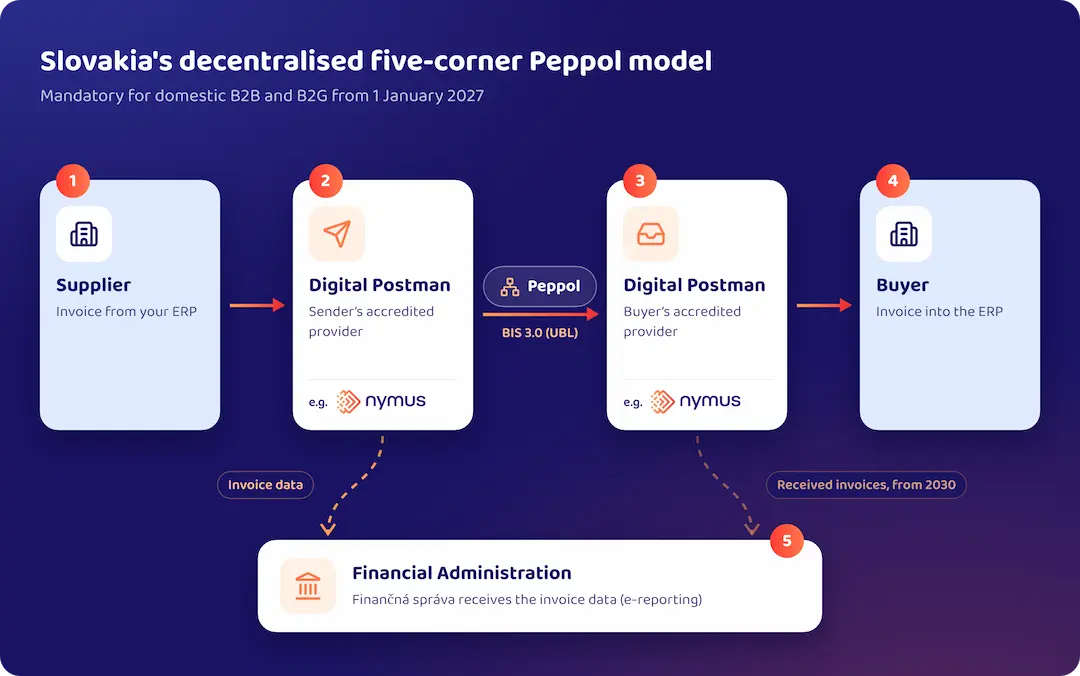
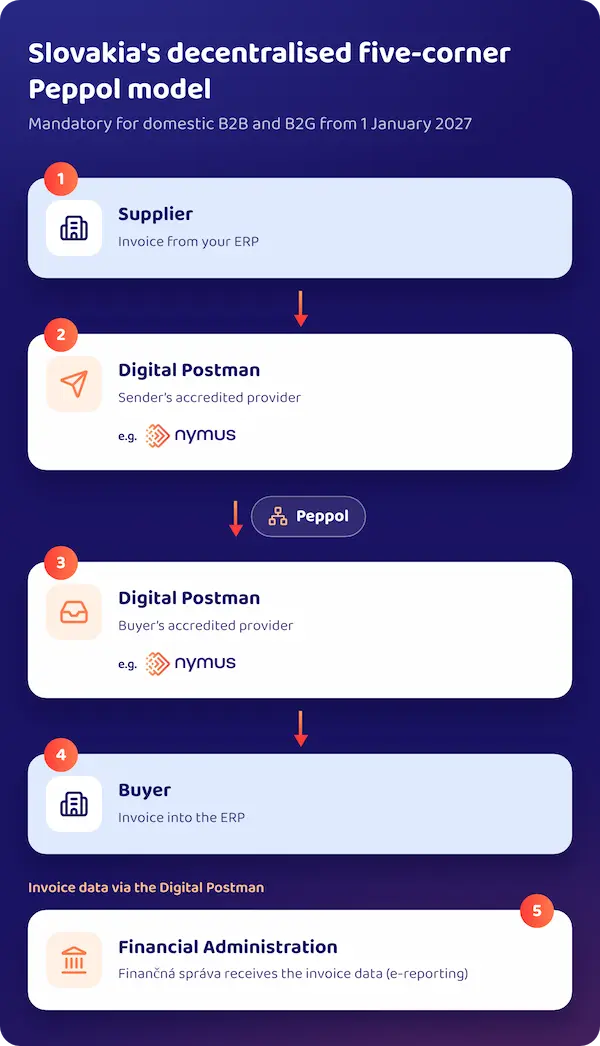
Seller and buyer exchange the invoice through their own service provider over Peppol (corners 1 to 4). The fifth corner is the Slovak tax authority, which receives the invoice data.
The Digitálny poštár (digital postman) is a service provider accredited by the tax authority. It sends and receives your invoices via Peppol and delivers the invoice data to the Finančná správa. The tax authority publishes a list of accredited postmen.
The Slovak financial administration is both the fifth corner and the Peppol authority for Slovakia. It publishes the Slovak validation rules and the VAT mapping your invoices must comply with.
Technical requirements
From 2027, every invoice is a structured XML file based on the European standard EN 16931. A PDF is no longer enough.
The standard format, in UBL 2.1 syntax. This is what you send and receive via Peppol.
Alternative syntax, only if buyer and seller agree on it and the invoice is fully EN 16931 compliant.
The European standard for the content of an e-invoice. Slovakia has no CIUS of its own on top of the standard.
On top of the standard, Slovak validation rules and a VAT mapping apply, published by the Finančná správa.
Which entity invoices in Slovakia, to whom and how much? Government, businesses or both? That determines what you need to arrange from 2027.
You need an accredited digital postman that sends, receives and reports via Peppol. Choose one that can also handle your other countries, so you don’t have to add a new provider for each country.
Your invoices must come out of your ERP as structured Peppol BIS 3.0 invoices, with the correct VAT data according to the Slovak validation rules.
From 1 January 2027, you will also receive e-invoices from your Slovak suppliers. Arrange how they flow into your accounting automatically.
Since May 2026, you can voluntarily connect and test. Use that time, so you don’t have to do everything at once in the last weeks of 2026.
Nymus is a Peppol Access Point itself and handles Slovakia directly, without intermediaries. One Belgian point of contact for the integration, the formats and the connection to the Slovak model.
Your invoices travel directly over the Peppol network, in the format Slovakia requires.
Our team is trilingual, familiar with the realities of doing business in Belgium, and understands cross-border compliance. No language barrier, no time difference.
You connect your ERP to Nymus once. After that, we activate Belgium, Slovakia or any other country without new IT projects.
Your invoice data is sensitive. Nymus protects it with enterprise-grade security certified by DNV.
Orac sends and receives e-invoices directly from SAP in nine European countries, including Slovakia. Hear first-hand how Orac stays compliant as the company expands country by country.
Other countries
Every country has its own rules, formats and deadlines. See how e-invoicing works in the other countries where you have an entity.

Mandatory receiving since 2025, mandatory sending phased in between 2027 and 2028.

Mandatory through an approved platform (Plateforme Agréée), with e-reporting and phased deadlines starting in September 2026.

B2G via the Peppol 4-corner model. A draft bill provides for a phased B2B requirement starting in 2028.

No B2B mandate. B2G is conducted via Peppol; B2B is currently voluntary, in line with EU plans.
Yes, from 1 January 2027. From then on, e-invoicing and e-reporting are mandatory for domestic B2B and B2G transactions. There is no obligation for B2C. A bill provides for a transition period in 2027 during which no penalties are imposed yet.
The standard format is Peppol BIS Billing 3.0 in UBL 2.1 syntax, compliant with the European standard EN 16931. If buyer and seller agree, UN/CEFACT CII is also allowed. On top of that, the Slovak validation rules and VAT mapping of the Finančná správa apply.
A Digitálny poštár (digital postman) is a service provider accredited by the Slovak tax authority. It sends and receives your e-invoices via Peppol and delivers the invoice data to the tax authority. Every company in scope chooses its own postman.
No. Slovakia uses a decentralized five-corner model on Peppol. The previously planned central IS EFA platform was never fully rolled out. The tax authority receives the data as the fifth corner, via your Digitálny poštár.
For now, the sender reports. Under the bill, reporting of received invoices by the buyer will only follow from 1 July 2030. You do need to be able to receive via Peppol from 1 January 2027.
In Slovakia, you generally keep invoices for ten years.
Yes. Nymus is a Peppol Access Point and handles your invoicing in Slovakia. We connect your ERP once and switch on Slovakia alongside your other countries, with one Belgian point of contact.
Not sure whether the mandate applies to your entity? Want to know the concrete steps for your ERP? Run it by us. We will analyze your situation and give you a clear answer.