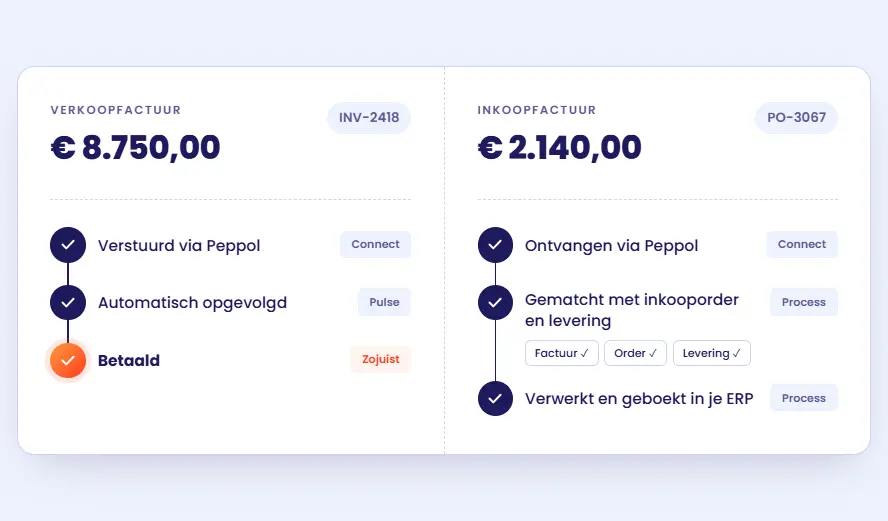
Switching to Nymus is a guided process, not a leap into the unknown. You’ll keep your Peppol ID, and your invoice flow will continue without interruption, even during the transition.
Most companies stay with a provider that no longer suits their needs for too long because switching seems like more of a hassle than the frustration they’re experiencing. Does this sound familiar?
Your invoices aren’t getting sent out, and you can’t get in touch with your provider. And even if you do reach them, they don’t offer a solution.
No support is provided when a country introduces a new format or mandate. The risk is yours, not your provider’s.
You’ve decided to implement a new ERP system, but your current provider can’t integrate with it.
You operate in multiple countries and work with a different provider in each country. You want to switch to a single partner that covers all your countries.
Invoices that are rejected or fields that are missing because your provider does not validate the data before sending it.
Communication outages or delays, and an internet service provider that leaves you in the dark.
The main reason people hesitate to make the switch is the fear that something will go wrong. At Nymus, that assurance doesn’t come from an “emergency stop” button after the fact, but from thorough preparation beforehand. We don’t switch over until the entire workflow has been tested and validated.
Your traffic will continue to flow before, during, and after the switchover. We’ll flip the switch at the agreed-upon time.
We validate the entire invoice flow in a test environment before making any changes to your live traffic.
Through the new integration, we’ll systematically organize your invoice data so that every invoice is complete and compliant when it’s sent out.
You’ll work with a team that understands your context and your ERP system, in Dutch, French, and English.
A project-based, predictable approach. We build the right solution first, and don’t switch over until it’s fully functional.
We’ll map out your entire environment: which ERP systems you use, what file formats and volumes are involved, and how many entities are involved. Based on that, we’ll propose the solution that best fits your situation.
We set up the integration between your ERP and Nymus. Your system sends your invoice data in our proprietary Nymus format, after which we verify that every required field is present and convert the invoice to the correct Peppol format for transmission. This ensures that every outgoing invoice is sent with complete, compliant data—even across borders. We thoroughly test the entire workflow before anything goes live.
The final step is the actual switchover. Your current provider will deregister your Peppol ID, and as soon as that’s done, we’ll register it with Nymus. From that point on, all your Peppol traffic will go through us.
Multi-ERP, multiple countries, numerous entities, and high volumes. These are precisely the environments found in large enterprises—where other providers fall short.
Your ERP system provides your data in a single format for all your countries. There’s no need for a separate integration for each country, and every required field is checked before an invoice is sent.
Quickly available in Dutch, French, and English. You’ll get a real answer to your question—and a solution.
Your billing data is sensitive. Nymus protects it with enterprise-grade security certified by DNV.
And it doesn’t stop with Peppol. Nymus Connect is your starting point, but the same platform evolves to support AP automation and credit management. So you’re not just building a single, standalone integration—you’re building a foundation for your entire invoicing cycle.
A migration is a project, not a simple switch. The timeline depends on the complexity of your environment: the number of ERP systems, the data formats, and the number of entities. During the initial consultation, we’ll provide you with a realistic timeline.
Nothing negative, and in the long run, even something positive. Your Peppol ID will remain the same, so your business partners won’t need to make any changes, and the message flows will continue as usual. Because we use the Nymus format, your invoices will contain more complete and cleaner data. This will allow your customers and suppliers to process them more efficiently.
Because our direct clients are large companies, we’ve deliberately chosen not to have thousands of them. As a result, we know each client personally, and you’ll have a human point of contact instead of an anonymous ticket system. We also don’t wait for you to report a problem—we proactively reach out to you about everything we’re doing for you. We serve smaller organizations through our partner network, ensuring that our direct clients continue to receive personalized service.
Since your ERP system sends your invoice data in the Nymus format via our proprietary integration, we check every invoice before it’s sent out. We verify that all required fields are present and correct, including country-specific fields for international invoices. Only then do we convert the invoice to the correct Peppol format and send it. This helps you avoid rejected invoices and subsequent corrections, and helps you build a more structurally sound dataset.
That depends on your previous provider. If they are able and willing to provide your message history, we’ll transfer it to the Nymus platform. Nymus can also provide an electronic archive.
Schedule a no-obligation migration consultation. Together, we’ll review your current environment and give you an honest assessment of whether and how quickly a transition is feasible.
Solutions
Learn more
Hoe ga je om met complexe e-invoicing scenario’s? Dat lees je in deze whitepaper. Vul het formulier in en krijg direct toegang tot de whitepaper.