
E-invoicing has been mandatory for domestic B2B in Belgium since 1 January 2026. Find out who it applies to, when and how to get compliant smoothly.


Yes. Since 1 January 2026, e-invoicing has been mandatory for domestic B2B transactions between VAT-registered businesses established in Belgium. There is no turnover threshold and no phased roll-out by company size: the obligation applies to everyone it covers at once. You send and receive structured e-invoices in Peppol BIS format via the Peppol network, no longer as PDFs.
For public contracts published after 1 March 2024, you invoice the government electronically. Here too, you send via Peppol, in Peppol BIS format, and your invoice arrives via Mercurius.
VAT-registered businesses established in Belgium send and receive structured e-invoices to and from each other via Peppol. A PDF sent by email no longer counts as an invoice in that relationship.
Cross-border B2B invoices fall outside the Belgian obligation for now. You can still send them via Peppol if your customer agrees. Under the European ViDA rules, e-invoicing and digital reporting for intra-community B2B transactions become mandatory from 1 July 2030.
If you supply the government, you invoice electronically for contracts published after 1 March 2024.
E-invoicing mandatory for domestic B2B between VAT-registered businesses established in Belgium. Fines since 1 April 2026.
Invoice data goes to the tax authorities in near real time. The preliminary draft bill has been approved, but the law is not yet final.
European e-invoicing and digital reporting for intra-community B2B transactions.
Belgium has opted for a decentralised model on Peppol. No central government platform, but a network of certified Access Points. From 2028, e-reporting to the tax authorities will be added.
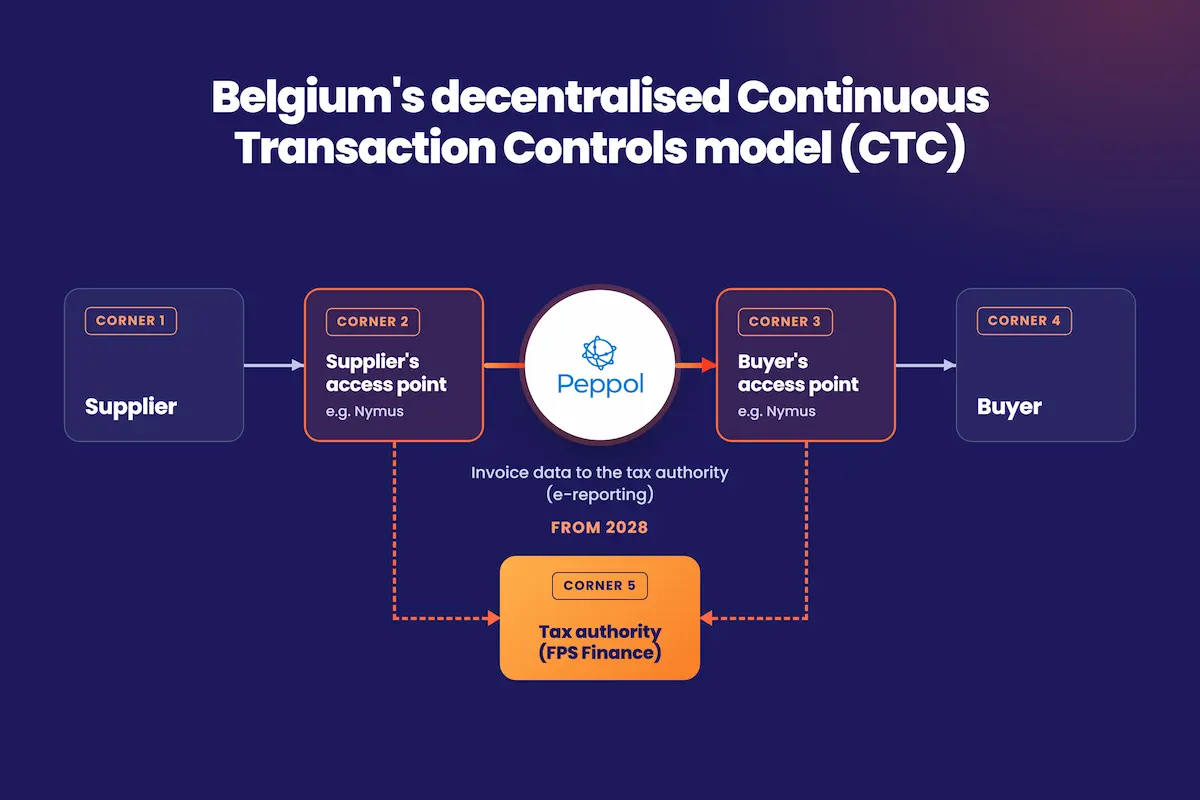
Seller and buyer exchange the invoice via the Peppol network. Each party is connected through its own Access Point, so you can invoice any customer or supplier on Peppol, regardless of the software they use.
A certified Peppol Access Point, such as Nymus, converts your invoice into the right format, validates it and sends it over Peppol. Incoming e-invoices arrive in your accounting system via the same Peppol Access Point.
From 1 January 2028 (planned), the Access Points of supplier and customer will deliver invoice data to the FPS Finance in near real time. The preliminary draft bill has been approved, but the law is not yet final.
Technical requirements
Since 2026, every domestic B2B invoice is a structured data file that your software can process automatically. A PDF or scan is no longer enough.
The standard format in Belgium. This is what you send and receive over the Peppol network via an Access Point.
The European standard for the content of an e-invoice. Peppol BIS is based on it.
Another structured format is only allowed if your customer agrees and the invoice complies with EN 16931.
A PDF sent by email or a scanned invoice does not count as an e-invoice, even though it is digital.
Before choosing a provider, you need to know how your invoicing really works today. The more complete that picture, the better you can compare later on.
Tip: work with one provider for all your countries. A different partner per country quickly becomes a hassle.
Based on your invoice flows, look for a provider that fits your situation, also if you operate internationally. When making the switch, many companies chose mainly on price, and as a result they get little efficiency out of e-invoicing.
E-invoices provide far more data than PDFs. At Nymus, we use that data to speed up your purchase-to-pay with smoother approval flows, and to optimise your credit management.
If you create the Peppol format yourself, your Access Point only forwards it. That format evolves and gets regular updates, so your own IT team has to keep it up to date and step in when something goes wrong.
With Nymus, you connect your ERP to our format once. We convert it into a correct e-invoice for every country and handle all updates ourselves. That takes the whole burden off your shoulders.
Even if you send few invoices yourself, you need to be able to receive and process e-invoices from your suppliers.
From 2028 (planned), your provider will report your invoice data to the government in near real time. Learn from the Peppol deadline: start on time and do not wait until the last minute. Check now whether your provider supports you in this.
Nymus is a certified Peppol Access Point itself and guides you from A to Z, even in complex and multi-ERP environments where other providers drop out. More than 2,100 companies already made the move.
No intermediary. Your invoices go directly over the Peppol network. Also active outside Belgium? Nymus has solutions in multiple countries, through a single integration.
Not happy with your current provider? We guide your switch, with a dedicated contact person who knows your situation.
SAP, Business Central, Oracle, AS400 or multiple ERPs at once: we connect where other providers drop out.
Your invoice data is sensitive. Nymus protects it with enterprise-grade security certified by DNV.
Orac sends and receives e-invoices directly from SAP, in Belgium and eight other European countries. Hear first-hand how Orac stays compliant as the company expands country by country.
Other countries
Do you also have branches outside Belgium? Each country has its own rules, formats and deadlines. See how e-invoicing works in the other countries where you operate.

Mandatory receiving since 2025, mandatory sending phased in between 2027 and 2028.

Mandatory through an approved platform (Plateforme Agréée), with e-reporting and phased deadlines starting in September 2026.

B2G via the Peppol 4-corner model. A draft bill provides for a phased B2B requirement starting in 2028.

No B2B mandate. B2G is conducted via Peppol; B2B is currently voluntary, in line with EU plans.
Yes. Since 1 January 2026, e-invoicing has been mandatory for domestic B2B transactions between VAT-registered businesses established in Belgium, with no turnover threshold.
After the grace period in the first three months of 2026, enforcement with graduated fines has applied since 1 April 2026. For self-billing, the grace period ran until 30 June 2026.
Companies that are not established in Belgium and have no permanent establishment here do not fall under the obligation, even if they have a Belgian VAT number. A foreign company with a permanent establishment in Belgium does fall under it.
In practice, yes. The obligation requires a structured e-invoice, by default in Peppol BIS format, which you exchange over the Peppol network via an Access Point. Another format is only allowed if your customer agrees.
No. The obligation applies to B2B transactions. Invoices to consumers (B2C) are not covered. You do need to be able to receive e-invoices from your own suppliers.
From 1 January 2028 (planned), near real-time e-reporting will be added on top of invoice exchange: invoice data will then go to the tax authorities in near real time. The preliminary draft bill has been approved, but the law is not yet final.
Not sure whether you are fully compliant, or want to switch to another provider? Our experts will look at where you stand today, together with you.