

In today’s digital world, efficiency is often the No. 1 priority. There are gains to be made for many companies by switching to e-invoicing. And in Belgium, e-invoicing is through Peppol, Pan-European Public Procurement Online. It is a network that allows companies to exchange electronic documents securely and efficiently with other companies and government agencies. In this article, we explain what Peppol is, discuss how it works, how to join the network and what the benefits are when you use it.
What is Peppol?
Peppol is a network that helps companies and governments exchange digital documents, such as invoices, in a standardized and secure way. You can compare it to an international postal service for digital documents. Instead of sending paper invoices through the mail, Peppol sends electronic invoices through a secure network.
This allows companies and governments to do business easier and faster. You don’t have to maintain 100 different formats or systems because it ensures that everyone speaks the same “language.” This makes the billing process much more efficient and reliable.
How does Peppol work?

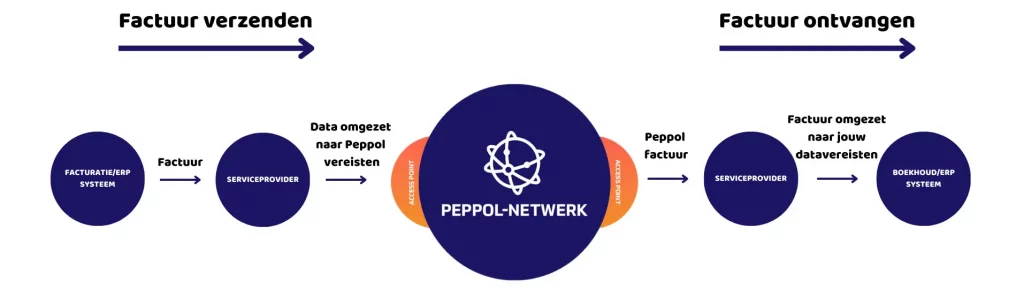
To send invoices via the Peppol network, you create them in your invoicing or ERP system. Once the invoice has been created, it is automatically sent to your service provider. The service provider automatically processes the invoice and converts the data into the Peppol format. The e-invoice is then sent via the Access Point to your customer’s Access Point.
If your customer also has a service provider, that service provider receives the e-invoice. If needed, they can convert the data into a format that is compatible with their accounting software or ERP system, without any human intervention. The whole process runs fully automatically.
The Peppol format for electronic invoices.
But what exactly is the Peppol format? In Belgium, the Peppol BIS 3.0 format is used. This format is based on UBL (Universal Business Language), a standard language for electronic business documents such as invoices and orders.
UBL ensures that all documents exchanged over the network have the same specifications. This allows documents to be processed automatically without human intervention, reducing the risk of errors and increasing processing speed.
Why was Peppol founded?
The system was created by the European Commission to make electronic commerce easier. It acts as a central registry for Access Points to which companies and governments are connected. This enables the exchange of e-invoices between different parties and provides a uniform standard for exchanging electronic documents within Europe.
Previously, countries and companies often used different systems and standards, which caused problems and inefficiencies. Now companies and governments can use one standardized system, which greatly improves cooperation and efficiency.
For whom is Peppol mandatory?
Since March 2024, companies are required to send invoices to government agencies through the Peppol network. Belgian companies must use their company and/or VAT number for registration within the Peppol network.
For B2B transactions, the deadline is a little later. As of Jan. 1, 2026, companies are required to exchange e-invoices over the network.
How do I join the Peppol network?
To send and receive invoices over the Peppol network, you must sign up with a Peppol Access Point. These Access Points act as gateways that enable the sending and receiving of e-invoices, similar to how telecom providers give you access to the GSM network.
It doesn’t matter which Access Points your customers are connected to because, as with messaging, your bill will be delivered even if your customer uses a different Access Point. Once registered, you will receive a unique Peppol ID.
What is a Peppol ID?
A Peppol ID is a unique identifier used to identify your company within the network. This ID is used to ensure that electronic documents are delivered correctly to the correct recipient. It is similar to a phone number, but specifically for exchanging electronic business documents within the Peppol network.
Your ID is usually set up with a prefix followed by an identifier such as the company number, for example. In Belgium, the prefix is mandatory ‘0208’. So Nymus’ Peppol ID is 0208:0845015696.
How do I choose a Peppol Access Point?
Choosing a Peppol Access Point is more important than you might think. Many companies assume that an integrated Peppol button in their ERP, billing or accounting package is sufficient, but that is not always the case. Therefore, think carefully about your needs and what your organization needs in terms of billing, compliance and scalability.
An e-service provider not only provides network access, but optimizes and automates your entire billing process, of which Peppol is just one part. This can make a world of difference for companies working with complex processes or handling a large number of invoices.
An e-service provider is the best choice when you:
- You have complex invoicing requirements: for example, if you need to work with advanced tax rules, different VAT rates or sector-specific standards. Think of industries such as logistics, retail or healthcare, where strict rules apply.
- You need integration with other business processes and systems: an e-invoicing service provider can integrate seamlessly with systems such as ERP, CRM or other accounting software, so that your invoicing process is fully automated.
- You want detailed reporting and analysis: if you want insight into your invoicing performance, such as payment terms, error rates or payment trends, an e-invoicing service provider can deliver valuable data. This supports better decision-making and helps you optimize your business processes.
- You have a high invoice volume: companies that send or receive thousands of invoices per month benefit from a robust and scalable solution to safeguard efficiency.
A Peppol button is often sufficient when you:
- You don’t need extra functionality: if your organization has a simple invoicing process and only wants to meet the basic requirements of electronic invoicing via the Peppol network, an integrated button may be sufficient.
- You have a small invoicing volume: for companies that only send or receive a limited number of invoices, a Peppol button offers a cost-effective and simple solution.
- You have limited need for integration or scalability: for smaller companies that do not need advanced links with other systems, a basic solution is often enough to keep working efficiently.

Safe network
The Peppol network allows you to exchange e-invoices securely. The network uses secure connections and encryption to prevent unauthorized people from accessing the data during transmission. In addition, all users must adhere to strict security rules making the network even more secure.
Benefits of Peppol
Invoicing via the Peppol network with e-invoices offers companies many benefits
- Efficiency: e-invoices are processed automatically, which saves time and costs.
- Fewer errors: standardization helps prevent manual data entry errors
- Compliancy: It complies with the rules for electronic invoicing in many European countries.
- Easy exchange: companies can easily exchange invoices with other companies and government institutions, regardless of their internal systems.
- Cost savings: less paperwork and administration lead to lower costs.
Why you shouldn't put off Peppol
It pays not to wait with the switch from traditional mail and email with PDF to Peppol. Many companies postpone this change until the mandatory 2026 deadline, but early integration offers major benefits.
It brings standardization and efficiency gains, so you can optimize your operational processes, reduce the administrative burden and keep errors in document exchange to a minimum.
By implementing early, you can gradually get familiar with the Peppol network and tackle any challenges and difficulties in time. That way you are well prepared for the 2026 obligation and gain a competitive advantage in today’s digital world.
Is it also mandatory in other countries?
Peppol is not only mandatory in Belgium and is becoming increasingly accepted and used worldwide. In Europe, it is especially popular in countries such as Poland, Norway, Portugal, the Netherlands and Germany where it is often mandatory for government-related transactions.
Outside Europe, countries such as Australia, Canada, Japan and Singapore have embraced the Peppol network as a standard for electronic invoicing, contributing to the system’s global interoperability and acceptance.
What is a Peppol schedule?
A Peppol schema defines how an electronic invoice, or other business document, should be correctly constructed. It is like the foundation of a Peppol document: it describes the structure, mandatory fields, allowed values and technical validations. Without a valid schema, an invoice cannot be sent or received through the Peppol network.
In technical terms, we talk about an XML or JSON based on UBL (Universal Business Language). The most commonly used schema is Peppol BIS Billing 3.0, but also future versions such as BIS 4.0 are based on this same logic.
Peppol schedules ensure that:
- Every invoice follows the same technical structure, such as a clear structure of header data, invoice lines and payment information.
- Mandatory fields, such as the VAT number, PO number or invoice date, are always filled in correctly.
- Invoices can be automatically validated via XSD and Schematron rules – an essential step to avoid errors and rejections.
- All parties in the network speak the same “language,” allowing invoices to be processed smoothly regardless of the ERP systems being used.
To enable error-free exchange, Peppol also uses standardized code lists, such as currencies, document types and payment methods, which are included along with the schema.
As a business, do you want to tackle e-invoicing correctly and scalably? Then it is essential that your solution follows the correct Peppol schema and is compatible with future updates such as BIS 4.0. Nymus ensures that your schedules are validated correctly and that your billing remains futureproof.
Conclusion
Peppol provides a standardized and efficient way for companies to exchange e-invoices and other commercial documents. By using Peppol, companies can improve their administrative processes, reduce errors and comply with legal obligations.
Whether you are a small business or a large multinational corporation, Peppol can help you streamline your billing processes and enjoy the benefits of electronic invoicing.
Why choose Peppol with Nymus
When you choose Peppol with Nymus, you get more than just a standard Peppol Access Point. Our solution offers a complete package that ensures a smooth exchange of e-invoices via the Peppol network, both between companies (B2B) and with governments (B2G).
With our central application, Peppol is seamlessly integrated into your invoicing process. That way you comply with all the rules effortlessly and can count on an efficient and reliable system for all your electronic invoices.
- We'll make sure you comply with all the rules without a lot of internal changes.
- We think with you to provide a solution to your current problems.
- We completely unburden you. You don't have to lie awake worrying about all the changes in technology, legislation and tax or financial obligations.
- Thanks to our innovative mindset, we are keeping up with AI and blockchain developments. As a result, our technology is on point.
- At Nymus, a personal approach is key. We can be reached quickly, are short on time and know our clients' organization.
Download our free e-invoicing whitepaper!
From the basics of e-invoicing and Peppol to the benefits and challenges of making the switch. Discover practical tips, a step-by-step plan and insights from Nymus customers.